
Hamstring Strain, Disc Herniation and Elbow Loose Bodies
3 Professional Sports Injuries.... 5/5/2026

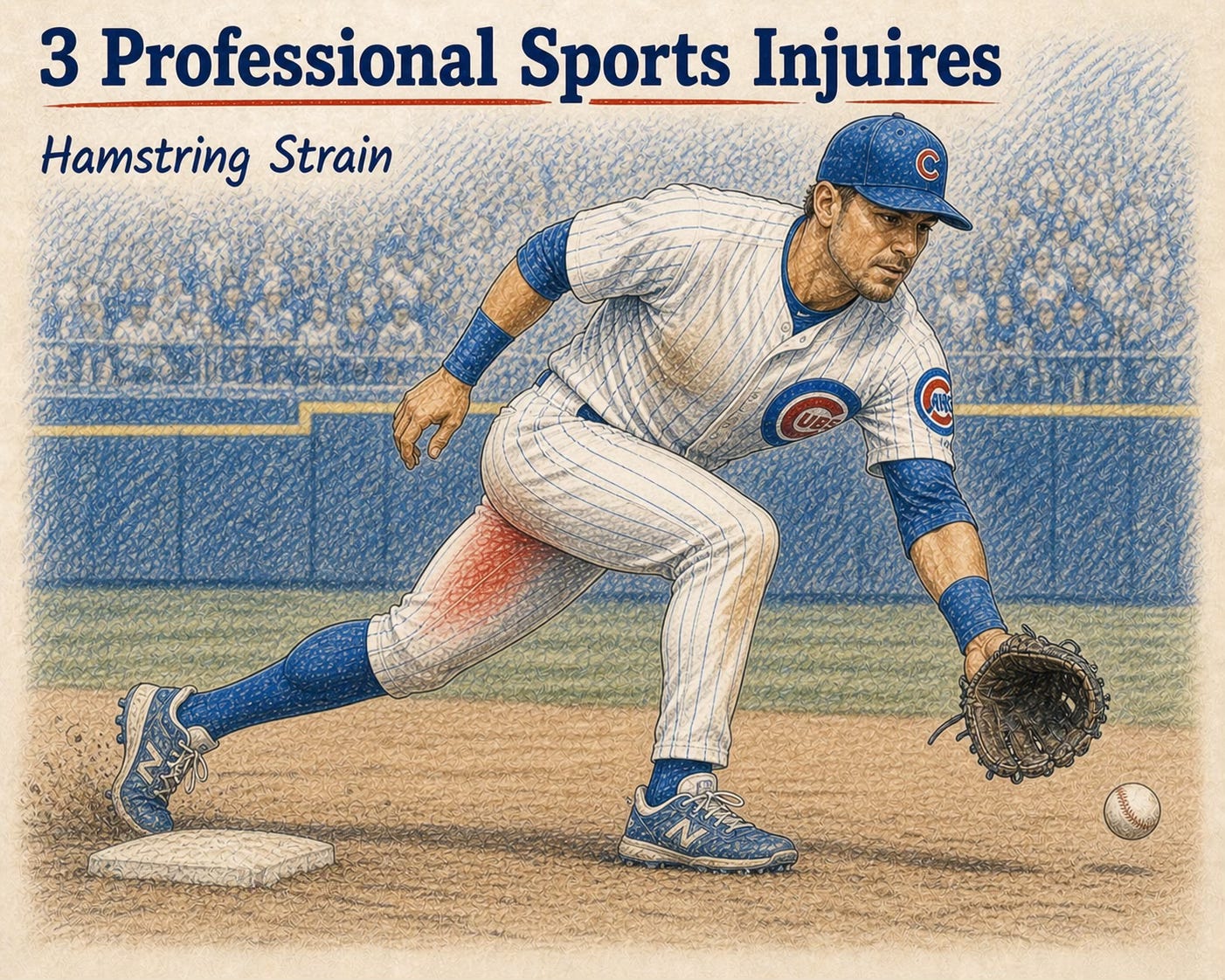
1. Ronald Acuña Jr. — grade 1 left hamstring strain
MLB — Atlanta Braves
Injury date: Saturday, May 3, 2026 (vs. Colorado Rockies at Coors Field)
Mechanism: Acuña was running out a ground ball to second base in the second inning. He pulled up, grabbed the back of his left leg, and was immediately removed from the game. Non-contact deceleration/acceleration injury — the hamstring was loaded eccentrically during the late swing phase of sprinting, which is the highest-risk moment for the muscle-tendon unit. The biceps femoris long head absorbs peak strain at terminal swing when the hip is flexed, and the knee is extending simultaneously.
Diagnosis: Grade 1 strain of the left hamstring, confirmed on MRI. Placed on the 10-day injured list. Manager Walt Weiss described it as “not overly serious but significant enough” to warrant IL placement.
Severity/timeline: Grade 1 is the mildest classification — microscopic fiber disruption without frank tearing or architectural distortion on imaging. Typical return is 2–3 weeks for a position player, though Acuña’s history demands a longer leash. He has had two prior ACL reconstructions. A surgically reconstructed knee alters hamstring loading patterns — the hamstring graft donor site (if an autograft was used) and the compensatory mechanics around the reconstructed knee both increase the risk of reinjury.
Conservative vs. surgical: No surgical indication for Grade 1 strains. Management is progressive loading: isometric holds, then eccentric loading (Nordic curls, Romanian deadlifts), then sport-specific acceleration/deceleration drills before returning to game action. The key is not rushing the return-to-sprint progression.
Literature: Ekstrand et al. (Br J Sports Med, 2016) demonstrated that hamstring re-injury rates in elite athletes are highest within the first 2 weeks of return, suggesting that time-based protocols underestimate the functional healing required. Askling et al. (BJSM, 2013) showed that eccentric-focused rehabilitation (L-protocol) led to a faster return to sport and lower reinjury rates than conventional stretching protocols. Prior ACL reconstruction increases ipsilateral hamstring strain risk by 2–3x (Toole et al., AJSM, 2021).
Teaching point: This is Acuña’s ninth trip to the IL in seven major league seasons. At some point, the question shifts from “what happened this time” to “what is the underlying movement or load management pattern that keeps producing these injuries?” Two ACL reconstructions fundamentally alter the biomechanics of the entire lower extremity. The hamstring is not failing in isolation — it is failing within a surgically reorganized kinetic chain that has been reorganized twice. Every return-to-play conversation needs to account for that history.
2. Luis Robert Jr. — lumbar disc herniation
MLB — New York Mets
Injury date: Sat out April 26–28 with lower back tightness; MRI confirmed herniation; IL placement retroactive to April 27, 2026. Eligible to return May 6.
Mechanism: Insidious onset. Robert sat out three consecutive games due to progressive lower back tightness before the Mets ordered imaging. No single acute event was reported. In a center fielder who sprints, dives, rotates through his swing, and decelerates from full speed, the lumbar spine is under constant combined loading — axial compression plus rotation plus shear. Disc herniations in athletes this age (28) are often the culmination of repetitive annular stress rather than a single traumatic event.
Diagnosis: Lumbar spine disc herniation. Specific level not publicly disclosed. Placed on 10-day IL retroactive to April 27.
Severity/timeline: The Mets are “optimistic” the stay won’t extend much beyond the 10-day minimum (eligible May 6). This suggests a contained herniation without significant neural compromise — likely a small protrusion causing local inflammation and protective muscle spasm rather than a large extrusion with radiculopathy. If he had leg symptoms or motor weakness, the timeline would be months, not days.
Conservative vs. surgical: Conservative management is appropriate for the vast majority of lumbar disc herniations, even in athletes. Initial management is activity modification, anti-inflammatory protocols, and core stabilization. Surgery (microdiscectomy) is reserved for cases with progressive neurological deficit, intractable radiculopathy, or failure of 6–12 weeks of conservative care. The 10-day optimism suggests this is not a surgical case.
Literature: Hsu et al. (Sports Health, 2010) reviewed lumbar disc herniations in professional athletes and found that 82% of MLB players returned to play at prior performance levels after conservative management. Earhart et al. (AJSM, 2012) showed that professional baseball players who underwent microdiscectomy returned at approximately 75%, with a mean absence of 8.5 months. The key prognostic factor is the presence or absence of radiculopathy.
Teaching point: This is Robert’s ninth trip to the IL in seven major league seasons — a pattern that raises the same systemic question as Acuña. But the lumbar disc issue is different from his prior muscle strains. A disc herniation at 28 in a player with this injury frequency suggests that his body is accumulating structural load faster than it can repair. The disc does not have a blood supply — it relies on diffusion for nutrition. Repetitive high-magnitude loading without adequate recovery windows accelerates matrix degradation in the annulus.
3. Tarik Skubal — left elbow arthroscopy for loose bodies
MLB — Detroit Tigers
Injury date: Announced May 4, 2026. Skubal had been dealing with elbow symptoms “off and on all year.” The acute event: during catch-play, his elbow locked up, similar to an episode in the seventh inning of his start in Atlanta the previous week (April 30).
Mechanism: Loose bodies in the elbow are fragments of bone or cartilage that break free from the joint surface and float within the synovial space. In a pitcher’s elbow, they typically originate from one of three sources: (1) osteophyte fragmentation from the olecranon tip or olecranon fossa — sheared off during the valgus extension overload of the acceleration/deceleration phases; (2) chondral flap detachment from the radiocapitellar joint under repetitive compression; or (3) osteochondritis dissecans lesions from adolescence that become symptomatic later. Skubal described the bodies as something he’d been managing all year — they float around without issue until they migrate into the articulation and mechanically block motion (”locking”).
Diagnosis: Loose bodies in the left elbow. Ligaments (UCL) confirmed intact on imaging. Arthroscopic removal scheduled.
Severity/timeline: Recovery from elbow arthroscopy for loose body removal is typically 2–3 months for a pitcher. Skubal is expected back by late August. The procedure itself is straightforward — the fragments are identified and removed arthroscopically, the joint is irrigated, and any associated synovitis is debrided. The key variable is the extent of chondral damage at the donor site where the fragments originated.
Conservative vs. surgical: Once loose bodies cause mechanical symptoms (locking, catching, loss of terminal extension), surgery is essentially the only answer. You cannot rehabilitate a fragment out of a joint. Anti-inflammatories and rest can reduce the reactive synovitis around the fragments, but the fragments themselves remain. Skubal tried to manage it conservatively all year — that approach works until it doesn’t, and “locking up during catch-play” is the point where it doesn’t.
Literature: Andrews & Timmerman (AJSM, 1995) published the landmark series on elbow arthroscopy in professional baseball players and found that loose body removal had the highest return-to-prior-level rate (88%) of any elbow arthroscopic procedure. Reddy et al. (AJSM, 2006) confirmed that isolated loose body removal without concomitant ligament pathology carries an excellent prognosis. The critical prognostic factor is the status of the UCL — Skubal’s is intact, which is the best-case scenario.
Teaching point: The financial context here is enormous — From a pure orthopedic standpoint, this is one of the more favorable diagnoses a pitcher can receive. Loose bodies are mechanical problems with mechanical solutions. The elbow locks because something is physically blocking it. You remove it, and the elbow stops locking. Compare this to UCL insufficiency or flexor-pronator tears, where the tissue itself has failed — those are biological problems requiring biological healing. Skubal’s ligament is intact. His tissue is healthy. He had debris in the joint. That is a clean problem with a clean fix.